|
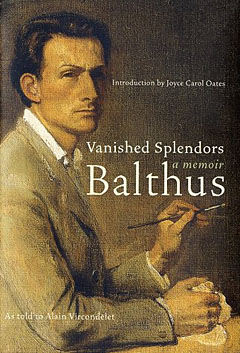
 Balthus,
Vanished Splendors, cover Balthus,
Vanished Splendors, cover
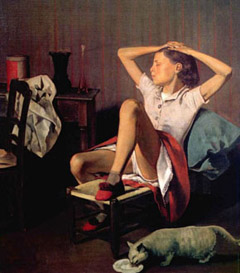
Balthus,
Thérèse Dreaming, 1938, oil on canvas,
collection
of the Metropolitan Museum of Art, NY
|
|
A secretive painter who defied lables
By Dan Tranberg
Known to the world simply as "Balthus," Balthazar
Klossowski was among the most enigmatic painters of the 20th century.
Born in Paris in 1908, he spent the bulk of his life secluded from the
public, produced some 350 paintings and 1,600 drawings and died in February
2001, 10 days before his 93rd birthday.
Though his paintings, which often depict girls in various states of undress,
can be found in some of the world's greatest museums, he remains an ambiguous
figure whose work never really fit into any major school or movement.
Some critics tried briefly to align him with the surrealists, because
of the dreamlike quality of his images, but the artist vehemently rejected
this. Others thought his work verged on pornographic, which, again, he
strongly denied.
So, who was Balthus? What was his deal?
"Vanished Splendors," the posthumously published memoir he dictated
to French journalist Alain Vircondelet, provides some answers but is far
from a juicy tell-all. Through its breezy, stream-of-consciousness narrative,
he emerges as a man earnestly trying to secure a sense of dignity and
respect. By and large, it works.
Balthus came from an intellectually privileged environment. His father
was a Polish art historian, painter and critic whose close friends included
Andre Gide and Pierre Bonnard. Two years after his parents separated in
1917, his mother became the lover of poet Rainer Maria Rilke.
Under Rilke's tutelage, the young Balthus began to flourish as an artist.
In 1921, when he was only 12, Balthus published a book of 40 drawings
with a preface by Rilke.
But although his early ties to the European intelligentsia obviously helped
him, Balthus spends much of "Vanished Splendors" describing
his personal life as a spiritual search rather than a climb to celebrity.
"I cultivated the taste for a certain secrecy not in order to make
myself important or attract galleries or collectors, but because the path
of silence and withdrawal is the only one that allows access to art's
secrets," he says.
Describing himself as "a very strict Catholic" but "not
a Catholic painter," he continuously portrays himself as being on
a quest for truth.
Regarding his frequent use of pubescent girls as subjects, Balthus says,
"I've always had a naive natural complicity with young girls,"
and "I always reject stupid interpretations that my young girls are
the product of an erotic imagination."
These statements are bound to raise eyebrows, and they undoubtedly contain
some amount of denial. But as much as Balthus refuses to accept the erotic
implications of his images, the integrity of his overall agenda as an
artist is believable.
In fact, the most pleasurable passages of the book are those in which
Balthus is not defending himself or trying to set the record straight,
but instead reveling in the magical process of making art.
In the end, he remains mysterious. Nonetheless, he stands as a painter
whose ardent devotion to the life of a secluded artist continues to intrigue.
Vanished Splendors: A Memoir
By Balthus, as told to Alain Vircondelet
Ecco Press, 272 pp., $29.95.
______________________________________________
This article appeared in The Plain
Dealer, January 19, 2003
© 2007 Dan Tranberg. All rights reserved.
|
|
|



