| |
SELECTED REVIEWS
AND ARTICLES
Balthus
Hernan Bas
Max Beckmann
Eric Bogosian
Michaël Borremans
Louise Bourgeois
James Casebere
Manierre Dawson
Christine Hill
Jim Hodges
Dennis Hollingsworth
William Kentridge
Michelangelo
Pablo Picasso
Dana Schutz
Julian Stanczak
John Szarkowski
Ai Yamaguchi
|
|
FEATURED ARTICLE
Spiegelman extols cartoons as art
 By
Dan Tranberg By
Dan Tranberg
Most people don't usually think of cartoons
as art. Despite the many skills required to create engaging stories though
images, cartoons and comic books remain entrenched in a category of artlike
activities in the shadow of traditionally esteemed art forms such as painting
and sculpture.
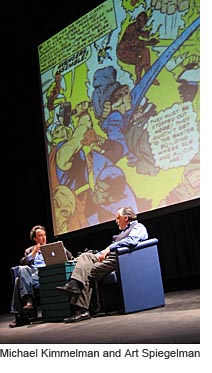
The state of comics as art served as the backbone for a public dialogue
recently at Cleveland Public Theatre on Cleveland's West Side. Pulitzer
Prize-winning artist and comic-book creator Art Spiegelman shared the
stage with Michael Kimmelman, chief art critic for The New York Times.
The event was the latest in an ongoing series of public talks called "Spectrum:
The Lockwood Thomson Dialogues," presented by the Cleveland Public
Library in partnership with the nonprofit Cleveland Public Art.
With Spiegelman's work projected on a large screen above the stage, Kimmelman
began the conversation by recalling the notorious 1990 exhibit at the
Museum of Modern Art in New York called "High and Low: Modern Art
and Popular Culture." That show effectively opened the door for a
wide range of topics, including the limited ways in which the art establishment
has embraced cartoons.
Spiegelman said he found the "High and Low" exhibition to be
"distasteful," particularly because it included very few comics.
He explained a hierarchy in the art world in which "painters are
on top" and "cartoonists are on the bottom."
Through the hour-long conversation, Spiegelman gave numerous examples
of how comics function as art, defining the genre at one point as "picture
writing" and saying that "stained-glass windows were the first
comics" because they are early examples of artists telling stories
in pictures.
Alongside this discussion, Spiegelman talked about his professional career,
which began when he was 16; he is now 59.
In addition to being known as a champion of comics as art, Spiegelman
is famous for his comic memoir "Maus I: A Survivor's Tale,"
released in 1986, and "Maus II: And Here My Troubles Began"
(1991).
"Maus," which tells the story of Spiegelman's parents surviving
the Holocaust, received great critical acclaim and led to a major exhibition
at the Museum of Modern Art in 1992 as well as a Pulitzer Prize that same
year.
His other accomplishments include successful commercial endeavors. He
invented Wacky Packs, stickers that parodied consumer products, in the
late 1960s. Later, he came up with Garbage Candy, miniature plastic garbage
pails filled with garbage-shaped candy.
Spiegelman also spent a decade working as an illustrator for the New Yorker.
Among the last and most unforgettable covers he did for the magazine,
just after the attacks of Sept. 11, 2001, was a depiction of the World
Trade Center's twin towers as a black silhouette against a slightly lighter
black backdrop.
Considering the vast breadth of Spiegelman's experience and accomplishments,
it's no surprise that he did the bulk of the talking during the dialogue.
Sensibly, Kimmelman functioned mainly as a guide.
In the lobby, after the talk, Kimmelman remarked, "Interviewing Art
is like turning on a switch."
___________________________________________
This article appeared in The Plain
Dealer, May 25, 2007
© 2007 Dan Tranberg. All rights reserved.
|
|
|



