|
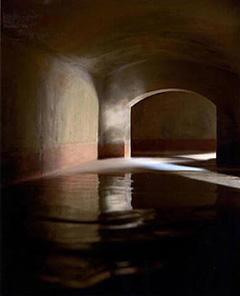
 James Casebere, Nevisain Underground #2, 2001 James Casebere, Nevisain Underground #2, 2001
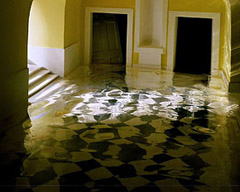
James Casebere, Yellow Hallway #2, 2001
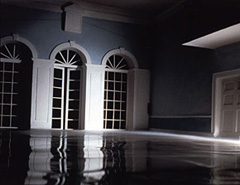
James Casebere, Monticello #3, 2001
|
|
Picture Paradox
By Dan Tranberg
Photography has reached new heights in recent years, thanks
both to an increase in available technology and to the talents of a generation
of artists who are using it in ways not previously possible.
Among them is James Casebere, whose haunting exhibition, "Picture
Show: James Casebere," opened last week at the Museum of Contemporary
Art Cleveland, formerly the Cleveland Center for Contemporary Art.
Casebere constructs tabletop architectural models using paper, plaster
and Styrofoam and then photographs them. But rather than printing his
images in the conventional way, in a darkroom, he scans them into a computer
and prints them with a Lambda printer, an enormous, super-high-quality
laser printer.
Using this process, Casebere has made photographs as large as 8 feet by
12 feet that are sumptuously rich and detailed. And he's not alone. Photographers
including Andreas Gursky, Jeff Wall, Thomas Struth and Gregory Crewdson
all use similar technology to make images that rival billboards and movie
screens.
That's part of the idea. Unlike many art photographers, even those from
the recent past, Casebere is more interested in the context of everyday
life than he is in the insular world of fine-art galleries. He has even
placed his work anonymously on the streets of New York City in order that
it might be seen by a range of viewers.
But as much as Casebere is interacting with society, his work looks nothing
like the art of social activists of the past. Rather than favoring easily
digestible information, he creates subtle, dreamlike images that tap into
deeply subconscious anxieties.
Many of Casebere's photographs look as though they were captured the day
after a disaster, such as a flood or a nuclear explosion. There's no real
indication of what exactly happened, but each image shows a room or hallway
that is flooded with water or is stripped of its functionality. At the
same time, each scene is strangely serene, often including the calming
suggestion of sunlight streaming through a small window.
This use of paradox is at the core of Casebere's strength as an image-maker.
Nothing is just one thing. His work is both beautiful and terrifying,
both soothing and full of anxiety.
From another angle, Casebere is toying with an issue that has become a
hot topic among contemporary photographers: the relationship between fact
and fiction. While he obviously goes to great lengths to make his models
realistic and to light them in a way that simulates reality, it remains
clear when viewing his scenes that they are, indeed, models.
This is not a matter of failing to produce a believable illusion. It is
part of the program. By allowing his models to retain some sense of artificiality,
Casebere is acknowledging the essential artificiality of his medium, the
fact that all photographs are constructions in some sense.
But in spite of the fact that the places you see in his work are models,
on an emotional level Casebere's images are as real as any dream or visual
impression. They trigger all kinds of thoughts and feelings, much in the
same way that movies do.
The richness and believability of Casebere's scenes, as well as their
emotional depth, is partially attributable to the artist's interest in
history. A series of images that resemble prison cells, for example, was
preceded by extended visits to actual prisons and extensive research into
the history of the prison system.
The same is true of a series based on Thomas Jefferson's Monticello and
another based on an academy in Massachusetts. Interviews with Casebere
reveal that his thoughts about these places delve deeply into the social
implications of the systems that created them.
As with all great art, the ideas contained within Casebere's work expand
as you look at it. His photographs are not only big, gorgeous images that
take advantage of cutting-edge technology, but also artful representations
of big ideas.
______________________________________________
This article appeared in The Plain
Dealer, December 13, 2002
© 2007 Dan Tranberg. All rights reserved.
|
|
|



