|
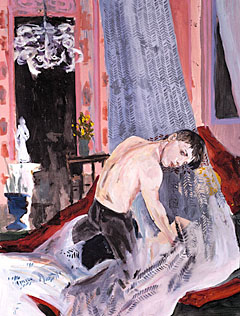
 Hernan
Bas, Red Herring, 2004, courtesy of Hernan
Bas, Red Herring, 2004, courtesy of
Saatchi Gallery, London
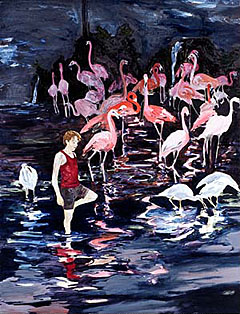
Hernan
Bas, Fitting In, 2004, courtesy of Daniel
Reich Gallery,
New York
|
|
Not Will and Grace
Hernan Bas at Daniel Reich Gallery
By Dan Tranberg
Twenty-four-year-old Miami-based artist Hernan Bas is one
of a growing number of emerging artists who makes figurative paintings
a la Henry Darger, working in an awkward painterly style that blatantly
favors psychologically rich narratives over technical mastery. But unlike
his stylistic counterparts (Elizabeth Peyton, for instance) Bas delves
into a highly charged social landscape, one occupied over the past decade
or two by writers such as Dennis Cooper and filmmakers such as Gregg Araki.
Bas himself cites earlier references: Oscar Wilde and French novelist
Joris-Karl Huysmans. Either way, he uses his work to wrestle with a seemingly
unavoidable queer pedigree.
His recent solo show at Daniel Reich Gallery, Sometimes with One I
Love, offered a dozen recent works in which slender teenaged boys
hover in a state between connection to and alienation from their environments.
Fitting In, a 31 x 24-inch painting on wood panel, was a clear
standout. A solitary figure stands in a shallow pool of water, mimicking
the pose of a flamingo while a large group of the flamboyant pink birds
carry on without noticing him. As with many of Bas’ works, the boy’s
surroundings can be seen as a stand-in for a conventional social network,
one with which the boy may want to blend, but obviously can’t. Right
Place Wrong Time uses a similar strategy; a boy shows up at a secluded
rocky beach, only to be left alone standing in the rain, holding a red
umbrella.
Such a sense of alienation and frustration is in many ways glamorized by Bas.
Confused and depressed as his characters often seem, they also imply a
certain cool detachment from the increasingly mainstream world of gay
assimilation. In this sense, Bas revels in the psychological ambiguity
that arises from not belonging to the relatively new world of gay normalcy.
Other works in the show depict more adventurous romantic scenarios. For
You It Has Come to This shows a group of boys about to engage in
fencing match. The setting could be a cave or the cellar of a castle—a
scene right out of a Hardy Boys’ mystery. Bas often draws upon such
innocently homoerotic sources; previous works use images from Boy Scout
manuals. Here again, he seems to be mining popular culture for subversive
behavioral clues, dissecting common imagery to reveal hidden implications.
On a formal level, Bas’ newest paintings are not as immediately
appealing as his works on paper, which were featured prominently in the
recent Whitney Biennial. Some of them become so clumsy that they simply
appear amateurish. A mixed-media installation in the rear of the gallery
was awkward to the point of failure, combining oversized theater props
with gravestone rubbings and Christmas lights in a cluttered pile of chaotic
symbols for death and drama.
Still, Bas has the potential to emerge as
a truly distinctive voice amidst a sea of new figurative artists. Like
the rarely seen gay-themed works of Charles Demuth, his best paintings
possess a tangible sense of an individual grappling with sexuality both
within and beyond conventional models of behavior.
Hernan Bas: Sometimes with One I Love
September 18 – October 31, 2004
Daniel Reich Gallery, New York
______________________________________________
This article appeared in Angle Magazine,
Issue #17, November / December, 2004
© 2007 Dan Tranberg. All rights reserved.
|
|
|



