|
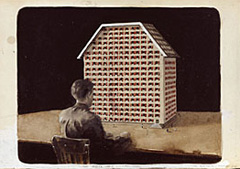
 Michaël Borremans, The
Journey (True Colours), Michaël Borremans, The
Journey (True Colours),
2002, courtesy Zeno X Gallery
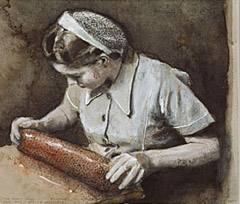
Michaël Borremans, The Ceramic Salami,
2001,
private collection, Brussels
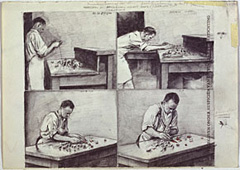
Michaël Borremans, Flattening a Hellhound, 2000,
private collection, courtesy Zeno X Gallery
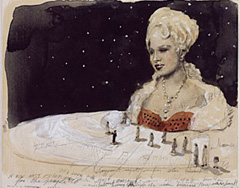
Michaël Borremans, A Mae West Experience,
2002, private collection, Los Angeles
|
|
Hallucination and Reality
By Dan Tranberg
We’re all trained from childhood to read pictures
like stories. But the pictures of Belgian artist Michaël Borremans
don’t work that way. Full as they are with seemingly narrative elements,
they’re deliberately befuddling. That’s part of what makes
them so mesmerizing.
Borremans’ exhibition, “Hallucination and Reality,”
on view at the Cleveland Museum of Art through Sunday, Sept. 4, is a magnificent
example of how an artist can take historical conventions and use them
to make works that feel entirely new.
Drawing upon influences ranging from Renaissance drawing to Surrealism,
Borremans creates hauntingly beautiful drawings and paintings that lure
viewers like glass-encased gemstones.
Once inside, we discover a world in which things don’t quite make
sense. Figures carry out indiscernible tasks, objects are depicted in
such a way that their scale is exaggerated beyond reason, and architectural
spaces defy the laws of gravity – not to mention logic.
This twisting of reality is not just a way for the artist to amuse himself;
it’s a way to draw viewers into his drawings and paintings in order
to appreciate them for what they are: wildly imaginative works of art.
Rather than creating stories, he combines disparate images so that they
read like dreams or nightmares.
A painting from 2002 titled “A Mae West Experience,” for instance,
shows a bust of the famous screen siren as if it were a public monument.
Comparatively tiny figures appear to walk around the statue, though many
are depicted as figurines, each mounted to a round base and therefore
immobile. Though the implied space in the painting is wide open, the frame
of a doorway appears on the periphery, as if leading viewers from one
realm into another.
The show is Borremans’ first solo museum exhibition in the United
States, and the Cleveland museum is its only American venue. It opened
last fall in Switzerland and traveled to Belgium before opening in Cleveland
on May 22.
Co-curated by Jeffrey Grove, who left his post as contemporary curator
at the Cleveland museum to become curator of modern and contemporary art
at the High Museum of Art in Atlanta, the Borremans exhibition is the
largest show ever in the museum’s Project 244 series, which Grove
initiated as a way of spotlighting new art.
It includes 63 small drawings and paintings, all created between 1995
and 2004.
Sprawling as it is, the show reveals Borremans as an exceptionally focused
artist, especially considering that the earliest works on view were made
when he was in his early 30s. He’s now 42.
For the past decade, he has been creating drawings and paintings using
photographs as source material, extrapolating and combining images to
create bizarre scenarios that often evoke issues of power and alienation.
But they never communicate concrete messages.
Borremans, who was present at the opening reception, said he intentionally
leaves his images open for interpretation and that he never starts them
with a clear plan in mind.
As a result, his works often include notes and diagrams, reflecting his
ongoing process of developing themes and ideas. He frequently reuses specific
figures or objects in a number of works, which reinforces the sense that
the viewer is experiencing a recurring dream.
Further tying all of his works together is his devotion to exquisite draftsmanship.
Unlike most contemporary artists, he cherishes the skills and techniques
of the old masters, and carries them forward with remarkable agility.
In light of the ongoing closings of the Cleveland museum’s permanent
galleries, the Borremans exhibition is now the main attraction in terms
of contemporary art at the museum this summer.
Delightfully puzzling as it is, it fits the bill beautifully.
___________________________________________
This article appeared in The Plain
Dealer, June 6, 2005
© 2007 Dan Tranberg. All rights reserved.
|
|
|



