|
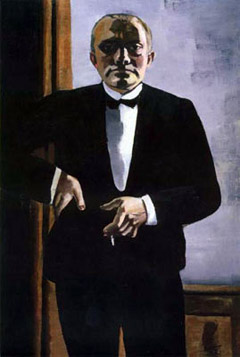
 Max Beckmann Self-Portrait in Tuxedo, 1927, Max Beckmann Self-Portrait in Tuxedo, 1927,
collection of Harvard University Art Museums
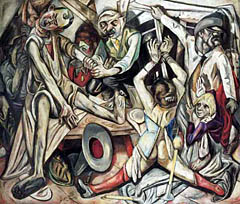
Max Beckmann,
Night, 1918-19, collection of
Kunstsammlung Nordrhein-Westfalen, Dusseldorf
|
|
Agony and Ecstasy:
The Dark Pleasure of Max Beckmann
By Dan Tranberg
Riding up the Plexiglas-encased escalator at the Centre Georges Pompidou
— gradually gaining a bird's-eye view of Paris — seems an
odd way to begin a comprehensive look at Max Beckmann, an artist known
for his subterranean visions of humanity's underbelly.
But once inside this enormous, beautifully-conceived exhibition, such
a privileged perspective on the world seems fitting; Beckmann clung to
his dead-serious view of the human race like a raven perched high in a
leafless tree, supremely confident that he was somehow elected to be above
it all. Solemnly gazing down on the mess of life, he depicted himself
most often in a black tuxedo with a dour expression on his face and a
cigarette dangling elegantly between two fingers.
Max Beckmann: A Painter in History manages to be both an informative historical survey and an
emotionally gripping ride though Beckmann's oeuvre. And large as it is
— including some 100 paintings, 60 prints, and several sculptures
— it's also a perfectly paced display, with ample white space between
each piece, many of which are the visual equivalents of punches in the
stomach.
Beckmann worked as a nurse in WWI, a little fact that may account for
his early fascination with human atrocities. He is said by some to have
been an arrogant, unpleasant man who preferred his own company to anyone
else's, and often went out in formal attire to sit alone and drink champagne
at the bar of an expensive hotel.
His major works span a period of 45 years, 1905 to 1950. Noteworthy is
the fact that this is precisely the era in which abstraction was born.
Beckmann disapproved strongly with this tidal shift, and declared that
abstract art was necessarily decorative and unfinished.
Interestingly, his attitude didn't prevent him from communicating through
the abstract elements of form and color. Beckmann spoke fluently with
paint in a language that was brutal and direct, but was also wildly exaggerated
for dramatic effect; Thomas Eakins he was not. Throughout his career he
frequently voiced his desire to capture the realities of life, the "terrible,
crude, magnificent, ordinary, grotesque, and banal,'' yet he did so with
little concern for illusionistic realism.
At the same time, mythology, religion and various forms of mysticism interested
him greatly. And herein lies the strange paradox of Beckmann's work. Nearly
every one of his paintings seems to argue both for and against the visceral
(and at times, the sensual) as well as the idea that the grit of life
can somehow be transcended.
This accounts for much of the simultaneous beauty and horror of his work,
filled with contorted figures and sinister faces, as if each character
is trying to wriggle out of his or her miserable existence. Still, Beckmann
had such a way with paint that it's hard not to ogle over the tactility
of his surfaces, the sheer power of his paintings as physical objects.
Major masterpieces such as "Night," from the collection of the
Kunstsammlung Nordrhein-Westfalen in Dusseldorf, are among the great pleasures
of the show, and a reminder that Beckmann produced a remarkable number
of ambitious paintings. Several of these will be familiar to American
museum goers, especially the Art Institute of Chicago's 1937 "Self-Portrait
in Evening Dress'' and MoMA's triptych "Departure.'' But the bulk
of the show is made up of works from European collections, both private
and public.
The Paris showing pulls off a rare curatorial feat; it includes a series
of films within the exhibition, each occupying a full room. Unlike the
traditional didactic version of this kind of supplement to a show, here
it is essentially a poetic expression of Beckmann's milieu. Black-and-white
footage, recalling both World Wars as well as the cabaret scene of Weimar,
successfully infuses the air with a sense of what Beckmann lived through.
Taking it all in, there is a surprising amount of pleasure in Beckmann's
work. Mixed in with all of his anxieties about life on earth is a palpable
sense of satisfaction in his act of processing it all through painting.
In 1938, in a speech he delivered in London, Beckmann said: "It is,
of course, a luxury to create art and, on top of this, to insist on expressing
one's own artistic opinion. Nothing is more luxurious than this. It is
a game, and a good game, at least for me; one of the few games that make
life, difficult and depressing as it is sometimes, a little more interesting.''
Max Beckmann: A Painter in History
Centre Georges Pompidou, Paris, 9/10/02 - 1/6/03
Tate Modern, London, 2/13/03 - 5/5/03
MoMA Queens, New York 6/25/03 - 9/30/03
______________________________________________
This article appeared in Angle Magazine,
Issue #1, March, 2003
© 2007 Dan Tranberg. All rights reserved.
|
|
|



