|
 Ai Yamaguchi Ai Yamaguchi
Ai Yamaguchi

Ai
Yamaguchi / Shu Uemura
|
|
A subtle sensation
By Dan Tranberg
Japanese painter Ai Yamaguchi is quickly becoming an international
sensation. In the past two years alone, she’s had three solo exhibitions
at major galleries in New York and Los Angeles, and last year she did
a series of drawings for the packaging of a line of skin-care products
by Shu Uemura, a high-end cosmetics company.
Now, Clevelanders can see what all the fuss is about by visiting Yamaguchiís
first U.S. solo show outside New York or Los Angeles: the exhibition “Ai
Yamaguchi: Oyasumi,” currently on view at Shaheen Modern and Contemporary
Art.
The 27-year-old artist flew in from Tokyo for the opening reception earlier
this month.
The exhibition of nearly 30 works quickly explains the artist’s
popularity; every piece in the show is exquisite. With an unfettered flair
for sensuous lines and gorgeous patterns, Yamaguchi merges traditional
Japanese painting and printmaking techniques with contemporary illustrative
styles often associated with Japanese animation.
But unlike many young Japanese artists who are feverishly bridging the
gap between fine art and popular culture (such as Yoshitomo Nara, who
was featured in a sprawling solo exhibition last fall at the Museum of
Contemporary Art Cleveland), Yamaguchi leans toward subtle beauty more
than bold graphic appeal. Originally trained as a textile designer, she
is remarkably attuned to minute details.
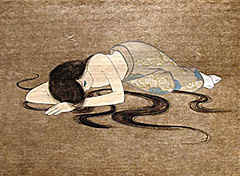
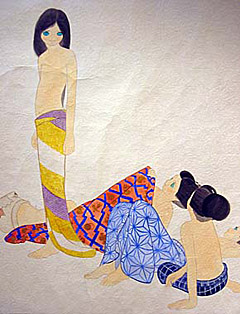
Beyond their sheer visual appeal, Yamaguchi’s works are fascinating
for the story they tell — an ongoing chronicle of nine fictional
girls who work as courtesans in a brothel. The tale is not presented in
a linear progression, but rather as a series of vignettes in which the
girls are often sleeping, and are either alone or grouped with other girls.
The subjects, who always have blue or green eyes, appear to be positively
innocent, though occasionally the depictions imply a touch of sternness
or perhaps sadness. Each girl has long, flowing black hair and is shown
against a blank background, sometimes on richly textured Japanese paper.
The impression they leave is one of delicate, complex sensuality, which
is exactly what distinguishes Yamaguchi from many of her popular contemporaries.
Earlier in her career, she worked as a studio assistant for Takashi Murakami,
a hugely successful contemporary artist whose work ranges from cartoonlike
paintings and sculptures to enormous inflatable balloons and commercially
produced merchandise such as watches and T-shirts.
While quieter and far subtler, Yamaguchi may be on a similar trajectory.
You can buy one of four T-shirts she designed for Giant Robot, a hip Japanese
pop-culture magazine (www.giantrobot.com), for $20, or a pick up a bottle
of Shu Uemura cleansing oil (www.shuuemura.com) with one of her drawings
on it for $60.
But rather than spoil it, commercial success will most likely serve to
enhance the complexity of Yamaguchi’s art. If there’s a fault
to it at all, it’s in its utter humility.
______________________________________________
This article appeared in The Plain
Dealer, October 22, 2004
© 2007 Dan Tranberg. All rights reserved.
|
|
|



