|
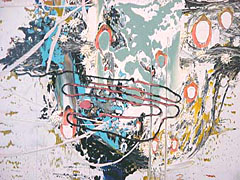
 Dennis Hollingsworth, Conus, 2002 Dennis Hollingsworth, Conus, 2002
|
|
Hollingsworth paintings cover
fresh territory
By Dan Tranberg
From one perspective, the recent resurgence of abstract painting shouldn't
come as a big surprise.
Following nearly two decades dominated by theory-laden postmodern art,
it makes sense that the pendulum would swing the other way - and that
artists would begin to re-examine the idea of art as a physical object
rather than a kind of sign that points only to an outside idea.
Nowhere can this tendency be seen more clearly than in the work of a handful
of abstract painters who are quickly becoming international figures in
the art world.
Among them is Los Angeles-based painter Dennis Hollingsworth, whose current
solo exhibition at Shaheen Modern and Contemporary Art in Cleveland is
as fresh as a stack of finger paintings about to be Scotch-taped to the
refrigerator.
Drenched in rich colors and thickly layered blobs of paint, the 12 paintings,
done in oil on paper, feel almost rebellious in their lack of overt statements.
At the same time, they are remarkably sophisticated paintings.
Hollingsworth, who was born in Madrid, Spain, in 1956 to a U.S. Air Force
father and a Filipino mother, spent time in the Navy before getting a
degree in architecture from California Polytechnic State University and
a master of fine arts degree from Claremont Graduate School in Claremont,
California.
It would be a stretch to talk about architectural qualities in his paintings,
because they're really about paint.
As if to immediately combat the idea that an abstract painting is somehow
empty, Hollingsworth creates a topographical complexity to his pieces
that gives them a palpable weightiness. If they weren't covered with glass,
it would be hard not to run your hands over their heavily textured surfaces,
which at times protrude as much as an inch from the paper.
Rather than using standard brushes, Hollingsworth builds his paintings
with a variety of homemade tools. As a result, many of his surfaces appear
to be more carved than painted.
Though there's ample variety in the group, they're all part of Hollingsworth's
"Wet on Wet" series, in which individual shapes and colors are
built up quickly without letting underlying layers dry.
This accounts in part for their spontaneous feel and the unfussy way in
which Hollingsworth creates intriguingly dimensional painterly spaces.
Each painting has a discernible background, seemingly made by gliding
a squeegee across copious dabs of paint, and more objectlike shapes that
sit on that surface like cake decorations.
Hollingsworth has developed a wonderfully quirky repertoire of these shapes,
which include sea urchin-like blobs whose tentacles have been drawn out
by patting the wet paint with a palette knife.
The loose, sculptural quality of these shapes is not unlike that of many
current abstract painters, most notably the increasingly well-known Michelle
Fierro, who also lives and works in Los Angeles.
But while this kind of technique can easily become decorative, gimmicky
and boring, Hollingsworth manages in his best works to make it a means
to an end rather than an end in itself.
"Here and There," one of the strongest works in the show, gives
the impression of a fish net that was just used to pull a load of jewels
up from the bottom of the sea. Woven into an intricate network of black
lines are prickly lumps of pure yellow and white, along with wobbly stands
of deep golden orange.
The sheer physical presence of this and other paintings in the show should
prevent Hollingsworth from being accused of merely rehashing the tactics
of the Abstract Expressionists or earlier modernists.
Although you could compare his work to painters like Dubuffet or Twombly,
Hollingsworth's raw and playfully loose use of paint definitely has a
flavor of its own.
But similarities between Hollingsworth and earlier painters are plentiful.
Besides his obvious avoidance of overt content, he clearly works in an
intuitive manner. By and large, that's not exactly how major painters
have operated for some time now.
Maybe that's why his paintings feel so new. It's hard not to wonder, however,
where Hollingsworth's strategies will lead.
On the one hand, it's refreshing to see a turn away from the kind of obscure
inside references that have plagued contemporary art for decades. On the
other hand, Hollingsworth doesn't seem to be attempting anything resembling
the modernist aim of transcending the physical. In fact, his paintings
quite blatantly revel in their physicality.
You could argue that Hollingsworth has abandoned painting's philosophical
aims and has settled on a sort of here-and-now, this-is-it, take-it-or-leave-it
approach.
But as painter and critic David Ryan asked in a recent essay on abstract
art: "With all the dangers of becoming embedded in a craft [process],
is abstraction anything more than a technical exercise that has become
distracted by its own repetitive production of familiar images?"
With these paintings, it's too soon to tell. In the meantime, though,
it's invigorating to see a body of work that rejects the hackneyed strategies
of postmodernism and aggressively attempts to break new ground.
______________________________________________
This article appeared in The Plain
Dealer, July 18, 2002
© 2007 Dan Tranberg. All rights reserved.
|
|
|



