|
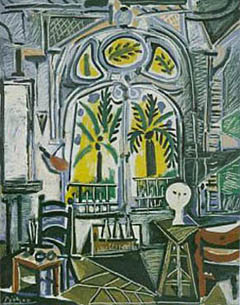
 Picasso, The Studio, 1955, Tate Gallery, London. Picasso, The Studio, 1955, Tate Gallery, London.
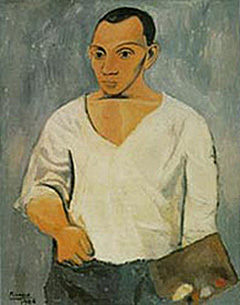
Picasso, Self-Portrait with Palette, 1906,
Philadelphia Museum of Art
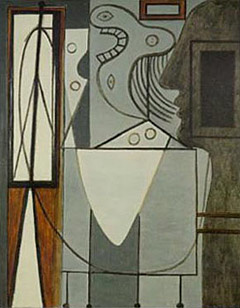
Picasso,
The Studio, 1928-29, Musèe Picasso
on deposit at the Centre Pompidou, Paris
|
|
The Drawing Room
By Dan Tranberg
He's been dead for less than 30 years, yet Pablo Picasso seems in many
ways like an artist from the distant past. His name alone conjures thoughts
of a time now long gone, when artists’ names became household words.
I remember when he died, his face was on the cover of Time. Things
don’t work that way anymore.
Picasso will always be a giant in the world of art, in part because his
career, which spanned more than 75 years, played a profound role in defining
the course of 20th-century art. You can quibble over whether or not Georges
Braque actually invented cubism, but no single artist covered more ground
in his lifetime than Picasso.
A general survey of Picasso’s career could fill a football stadium.
And though I like the idea of seeing his masterpiece, Guernica,
covering the digital scoreboard, a truly representative sampling of Picasso’s
massive output of paintings, prints, drawings, sculpture and ceramics
would probably be about as edifying as the Rose Bowl parade; it’s
just not possible to process that much information.
Out of necessity, Picasso exhibitions always focus on a narrow theme or
period. The Museum of Fine Arts in Montreal recently mounted "Picasso
Erotique," rounding up about 350 of Picasso’s most sexually
explicit works. Alas, no major American museum has ever been host to such
a bold display of erotica by any artist. In the early 1990s, the Cleveland
Museum of Art assembled "Picasso and Things," concentrating
on the artist’s still lifes. Now, nine years later, CMA presents
"Picasso: The Artist’s Studio," a modestly sized exhibition
of 45 works that highlights the studio as one of Picasso’s favorite
subjects.
The main exhibition space has been completely transformed for the show,
divided into seven quite beautiful and manageable rooms, five for the
actual art and two for educational displays. And though opinion is bound
to vary, I found the overall number of works and the way the show is arranged
to be perfectly gratifying for a single visit.
But why this issue of the artist’s studio? The subject was of no
small importance to Picasso; it appeared repeatedly, though not consistently,
from his earliest studies to works he completed within a year of his death
in 1973. According to curator Michael Fitzgerald, who assembled the exhibition,
during the last decade of Picasso’s life the image of the artist’s
studio virtually consumed all other subjects.
The show wavers slightly in its focus on the studio as a recurring image
for Picasso, especially with the inclusion of still lifes that are not
really about the studio as much as they just happen to be set in one.
Nonetheless, a good number of strong paintings and drawings manage to
carry the show’s weight.
In a few of the earliest works, done before the turn of the century, neither
the subjects nor the settings seem especially meaningful, but that soon
changes. Images of paintings begin to appear within the paintings, either
resting on easels or against walls; and the artist himself appears, not
sitting passively for a portrait, but participating actively in the scene.
The shift suggests, at least in part, that Picasso was quite taken with
both the idea and the image of himself working away in his studio. The
powerful 1906 Self-Portrait with Palette, on loan from the Philadelphia
Museum of Art, is practically a monument to the artist’s assuredness.
He stands alone in the center of the painting, like a stone fortress,
daring you to challenge him.
Many of the works in the show focus more on the studio than on the image
of the artist. A fabulous little 1920 drawing titled The Artist’s
Studio in the Rue La Boetie, on loan from the Musèe Picasso
in Paris, depicts countless paintings and drawings strewn among upholstered
chairs and a pedestal table. While the drawing clearly celebrates the
excitement of an artist’s space, it also demonstrates what was arguably
Picasso’s greatest talent: his supremely confident use of line.
The image is made up solely of uniform pencil lines, tracing the contours
of each object in the room.
In the late 1920s, Picasso’s use of line became the dominant force
of his paintings. The exhibition’s second room showcases this fact
with a group of works that by themselves make the show worth seeing: The
Studio, from 1927-28, on loan from New York’s Museum of Modern
Art; Painter in His Studio, a 1928 canvas from a private collection;
and Painter with Palette and Easel, from the Musèe Picasso.
This group conveys an overwhelming sense of how Picasso used line rather
than color to sculpt forms in space. In these and other works, every shape
is delineated by harsh black lines that take on a decorative quality not
unlike that of wrought-iron gates and fences.
Interestingly, a tiny 1922 painting that hangs nearby functions in nearly
the opposite way. Titled Nude with Drapery, it is modeled entirely
with rough yet gradated brushstrokes that reveal the figure’s weighty
substance. Besides being a great little painting, it highlights Picasso’s
remarkable ability to paint in any style he chose.
Following the show’s chronological path, it’s difficult not
to marvel at the brute force with which Picasso attacked painting. Even
after the rise and fall in popularity of the neo-expressionists of the
1980s, who favored violent emotion over cool restraint, Picasso seems
like a bull of a painter. And yet who paints like this anymore? Recent
years have shown a rise in interest in the physicality of painting. But
Picasso didn't just adopt this idea as a strategy; he lived it. In an
era when twentysomething art stars appear and disappear in the span of
a few years, Picasso remains a force to be reckoned with.
______________________________________________
This article appeared in The Free
Times, October 31, 2001
© 2007 Dan Tranberg. All rights reserved.
|
|
|



