|

 Dana Schutz, Fanatics, 2005 Dana Schutz, Fanatics, 2005
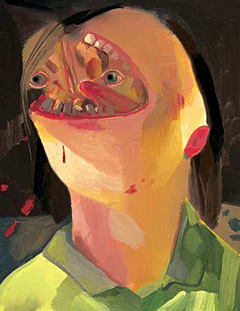
Dana Schutz, Face Eater, 2004

Dana
Schutz, Men's Retreat, 2005
|
|
Dana Schutz at MOCA Cleveland
By Dan Tranberg
In the mid-1950s, in his book “A Coney Island of the Mind,”
poet Lawrence Ferlinghetti wrote: “In Goya’s greatest scenes
we seem to see the people of the world exactly at the moment when they
first attained the titled of ‘suffering humanity’.”
Fifty years later, Dana Schutz’s paintings seem to depict an updated
vision of our tormented race, recalling a later line Ferlinghetti’s
poem: “They are the same people, only further from home.”
Schutz often shows mangled figures whose features are skillfully garbled
through her virtuosic handling of paint. But, unlike Francisco Goya, the
early nineteenth-century painter famous for brutal depictions of such
subjects as “Saturn Devouring his Son,” Schutz’s images
are often devoid of any overt sense of horror. Instead, we see her characters
against cheery blue skies or in otherwise benign scenes that belie the
grim nature of their apparent circumstances.
Six years after her graduation from the Cleveland Institute of Art, Schutz
is in a position that very few artists reach in their lifetime. At age
30, her works hang on the walls of New York’s most prestigious museums
of contemporary art: The Whitney, MoMA, and The Guggenheim. She’s
also been in dozens of high profile shows all over the U.S. and Europe.
She’s far beyond being a hot young artist. She’s a phenomenon—one
that continues to defy the flash-in-the-pan syndrome so common to young
art stars. Just when everyone is marveling at how far she’s gone
in her career, she goes even further.
The most recent development in Schutz’s ever-soaring career is the
traveling exhibition “Dana Schutz: Paintings 2002-2006,” organized
by the Rose Museum of Art at Brandeis University, Waltham, Massachusetts,
where it opened in January. Curated by Raphaela Platow, curator at the
Rose, the exhibition will travel to the Museum of Contemporary Art Cleveland
this fall, where it will be on view from September 29 through December
30.
Featuring roughly 18 paintings, it is the first comprehensive solo museum
exhibition of Schutz’s work, and is said to include three paintings
created especially for the Cleveland installation of the show, coordinated
by MOCA Cleveland’s senior curator, Margo Crutchfield.
Given that Schutz, a native of Michigan, spent five years in Cleveland,
the show is sure to be a hit in the town where she spent her undergraduate
years. But it will also inevitably beg the question: Why is she such an
art-world marvel?
Here’s one attempt at an answer: One top of being, on a personal
level, intelligent, funny, and delightfully quirky; and besides her deft
use of crazy colors, erratic yet controlled brushstrokes, and endlessly
alluring imagery; Schutz is among very few artists of her generation who
creates images that contextualize a world in which terror has become commonplace.
While Goya’s paintings served as an indictment of crimes against
humanity—wake-up calls to the public—Schutz’s seem to
cast today’s atrocities in an absurdist, almost humorous light.
This is especially true of recent works such as “Autopsy of Michael
Jackson,” a play on the media’s scrutiny of the pop star,
and “Poisoned Man,” a bloated facial portrait reportedly inspired
by news reports about the poisoning of Viktor Yushchenko, President of
Ukraine.
It is not as if Schutz is making fun of these people or their situations.
It is as if she is placing them in a context consistent with today’s
world. Repeatedly bombarded by deadpan news reports of unfathomable tragedies,
the realities of war, murder, and torment have, for many of us, become
incomprehensible abstractions.
As one voice of a generation of Americans who came to adulthood post-9/11,
Schutz—to paraphrase Ferlinghetti—shows us the people of the
world long after attaining the title of suffering humanity. And they (we)
are much further from home.
Dana Schutz: Paintings 2002-2006
Museum of Contemporary Art Cleveland
September 29 - December 30, 2006
______________________________________________
This article appeared in Angle,
Issue #28, Sept/Oct, 2006
© 2007 Dan Tranberg. All rights reserved.
|
|
|



