|
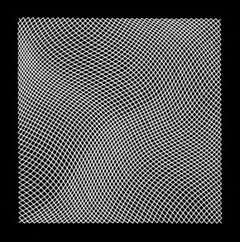
 Julian Stanczak, Tense Cluster, 1966 Julian Stanczak, Tense Cluster, 1966
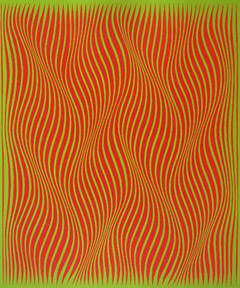
Julian Stanczak, Obsession II,
1965, collection of
Neil Rector, Columbus, Ohio
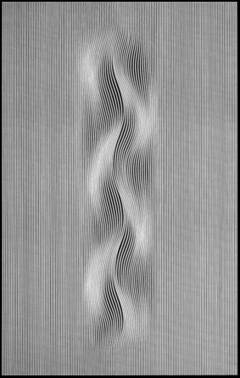
Julian Stanczak, Elusive, 1995, collection of
Robert Mann
|
|
Eye to Eye
By Dan Tranberg
It’s been a while since art explicitly about visual perception has
been at the forefront of the art world. Though an acclaimed retrospective
of works by British Op artist Bridget Riley opened at New York’s
Dia Center for the Arts earlier this year, the visually dazzling geometric
patterns of Op art made only a brief splash in the mid-’60s, then
were quickly disseminated as sources for fabric designs and psychedelic
bric-a-brac.
A recent resurgence of optically oriented abstraction has stirred new
interest in Op art. Lucky for us, its key pioneer, Julian Stanczak, lives
right here in Cleveland. A major retrospective of Stanczak’s work,
currently on view at the Cleveland Institute of Art’s Reinberger
Gallery, traces the progression of Stanczak’s art from his early
studies through works that typify Op. But what the show celebrates is
not the "Cleveland connection" to a famous art movement; it
is the remarkable life and work of an artist determined to find clarity
in a world of chaos.
Julian Stanczak has been making art for nearly six decades. In less than
half that time, he became a prominent American artist, represented in
New York by the Martha Jackson Gallery and featured in the 1965 exhibition
The Responsive Eye at the Museum of Modern Art. Remarkably, he accomplished
all of this after losing the use of his right arm as a precocious (right-handed)
teenager.
By the time Stanczak arrived in Cleveland at the age of 21, he had experienced
far more horror than most witness in a lifetime. In 1940, when he was
11 years old, Stanczak and his family were forced from their home in Poland
into a Siberian labor camp. They escaped in 1942, traveling on foot until
they met up with the exiled Polish army. Out of desperation, Julian (at
age 13) had to leave his family, lie about his age, and join the army
"because they had food." But severe illness and the loss of
the use of his right arm left him no choice but to desert.
He found his mother and sister in a refugee camp and retrieved his brother
from an orphanage. Together, the family traveled to India, then finally
to a community of Polish exiles in the jungles of British Uganda, where
they were detained for the next seven years, living in straw huts. Because
Stanczak’s father was serving in the Polish Army under British command,
and Poland’s newly formed Communist government prevented the family
from returning to their homeland after the war, the Stanczaks were eventually
granted permanent residence in England. After two years, they emigrated
to the U.S., first to New York, then to Cleveland, where jobs were available.
Soon after arriving, Stanczak enrolled as a student at the Cleveland Institute
of Art.
"I was born at age 21 in Cleveland, Ohio," he recently remarked
while standing in front of one of his new paintings. But though Stanczak
has every right and reason to feel that way, his life and his art stand
as a testament to the triumph of his will. The Op art of the 1960s is
only part of the picture. The most exciting part of the show, in fact,
is Stanczak’s recent work, in which seemingly random elements are
incorporated into linear systems, producing images of amazing visual subtlety
and perceptual complexity.
Considering his tumultuous youth, it’s not difficult to surmise
that Stanczak sought order and control in art. Tracing his early works,
one can see a clear progression from an intuitive attraction to rhythmic
patterns to an increasingly systematic analysis of form and color. Crucial
to these early developments is Stanczak’s tutelage under the man
he referred to as an "expert in the mystery of color," Josef
Albers. Stanczak studied with Albers at Yale, where he received his MFA
in 1954. Clearly, Albers helped Stanczak refine his understanding of the
interaction of color. But it was Stanczak’s own ingenuity that lead
him to develop images accentuating physical sensations associated with
vision.
When Martha Jackson chose the title Optical Paintings for Stanczak’s
first solo show at her gallery in 1964, and a Time magazine review contracted
optical to "Op," the term "Op art" was born. But neither
Stanczak nor Albers approved of it. Albers commented at the time that
"perceptual art" would be a more appropriate term, undoubtedly
because the word "optical" connotes only sight and not the more
complex issues of perception, into which Stanczak was clearly tapping.
Regardless of art-world buzzwords, Julian Stanczak’s lifetime of
work is an odyssey that will likely take years to fully appreciate. Perhaps
the greatest benefit of seeing a half-century worth of his work is the
inevitable realization that Stanczak’s art has very little to do
with a passing trend. Rather, it’s about the basic human need to
understand our connection to the physical world. Ultimately, his paintings
are not lessons in vision; they’re lessons in life.
______________________________________________
This article appeared in The Free
Times , September 12, 2001
© 2007 Dan Tranberg. All rights reserved.
|
|
|



